
Father
Archetype
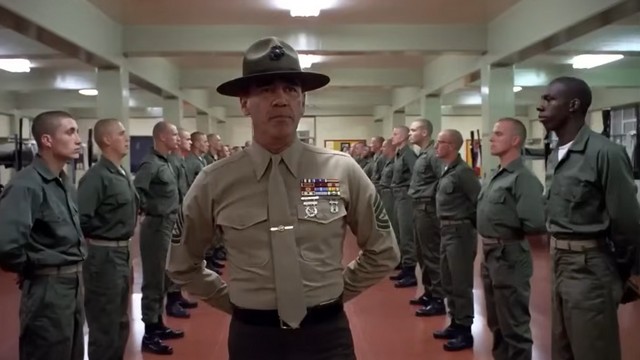
“I am hard, but I am fair.”
—Sgt. Hartman
Full Metal Jacket (1987)
Father Characters
Archetypal fathers appreciate rules and structure. They believe there are clear lines between right and wrong and between truth and falsehood. And they believe social hierarchies are important for maintaining order and legitimizing authority. Father characters tend to see themselves as men and women of principle. They often represent impartial judgment or hierarchical power. They also symbolize the sterility and brittleness of rigid rules, protocols, and structures.
Archetypal fathers are serious people (at least in their own estimation). They usually hold positions of formal authority. They’re aristocrats, legislators, priests, professors, police or military officers, corporate executives, middle managers, or simply the heads of their respective households. Father characters respect the ranks and titles designated by legitimate institutions. Their attitudes range from chivalrous to stoic to self-righteous to severe and puritanical.
Prominent Examples
- Marshal Will Kane in High Noon (1952)
- Mr. Banks in Mary Poppins (1964)
- Nurse Ratched in One Flew Over the Cuckoo’s Nest (1975)
- Shaw Moore in Footloose (1984)
- Sgt. Hartman in Full Metal Jacket (1987)
- Judge Thomas Danforth in The Crucible (1996)
- Hank Hill in King of the Hill (1997–2010)
- Walter Sobchak in The Big Lebowski (1998)
- Shifu in Kung Fu Panda (2008)
- Ned Stark in Game of Thrones (2011–2019)
Definition
The father archetype is rooted in notions of structure and rules. It reflects an intuitive sense that there’s a hidden order beneath the apparent random and arbitrary nature of the world. Whether it’s divine power or a system of natural laws, there are unseen forces that govern the universe. The father archetype also reflects the notion that our lives ought to be governed by formal laws, ethical norms, and social hierarchies.
Dramatic Dimensions
Archetypes are fluid orientations, not rigid types. These are common tendencies and associations—they may or may not apply in any particular case.
Narrative Roles
Motivations
Virtues
Vices
Perceptual Frames
Growth Opportunities
Taxonomy
Father Variants
Pairing
- Child: Father characters tend to see archetypal child figures as needing guidance and discipline.
- Hero: Father characters often admire heroes unless or until they’re deemed dangerous.
- Maiden: Father characters see archetypal maidens as too emotional and too concerned with other people’s opinions.
- Mother: Archetypal fathers and mothers may be aligned in their interests until loyalties are pitted against principles.
- Trickster: Archetypal tricksters frequently disrupt the order and stability prized by father characters.
See the whole taxonomy on the archetypes overview page.
Learn more
Volume 2 of The Writer’s Guide to Archetypes: Elemental Dynamics of Character and Drama will feature a deep exploration of the
Father
archetype. It’s expected to be available in 2029.
Join the mailing list to stay up to date on the publication date and get discounts and previews.