
Archetypes
Character Archetypes
Child
An orientation of vulnerability, dependence, and ignorance.
Primary concerns: Safety vs risk or danger, comfort vs difficulty, and curiosity
Variants: Apprentice | Divine Child | Eternal Child | Orphan | Victim
Hero
An agential orientation toward long-term goals.
Primary concerns: Achievement and integrity
Variants: Artist | Builder | Lover | Outlaw | Seeker | Warrior
Maiden
An orientation toward personal relationships and the self as a social agent.
Primary concerns: Compassion vs cruelty; adoration vs shame
Variants: Good Girl | Ice Queen | Virgin | Vixen
Trickster
A receptive and responsive orientation toward observation and subjective experience
Primary concerns: Beauty & pleasure vs ugliness; vibrance vs sterility
Variants: Fool | Jester | Mystic | Provocateur | Tempter
Mother
An orientation toward the cycles and interconnections that generate and support life.
Primary concerns: Survival & health vs disease & death; function vs dysfunction
Variants: Caregiver | Dragon | Earth Mother | Martyr | Queen | Terrible Mother
Father
An orientation toward abstraction and rules.
Primary concerns: Order vs chaos; legitimacy vs fraudulence
Variants: King | Scholar | Sky God | Tyrant | Votary
Shadow
An avoidant orientation toward certain aspects of one’s own personality and temperament.
Primary concerns: Denial and self-criticism
Variants: Beast | Demon | Golden Shadow
Animus/Anima (Animum)
An orientation toward the unexplored capacities of the self.
Primary concerns: Fascination and exploration
Variants: Bad Boy | Knight | Princess | Shapeshifter | Wild Woman
Magician
An orientation toward integration, wholeness, and transcendence.
Primary concerns: Integration & harmony vs discord; balance vs volatility
Variants: Eidolon | False Prophet | Godhead | Sage | Syzygy
Archetype Relationships
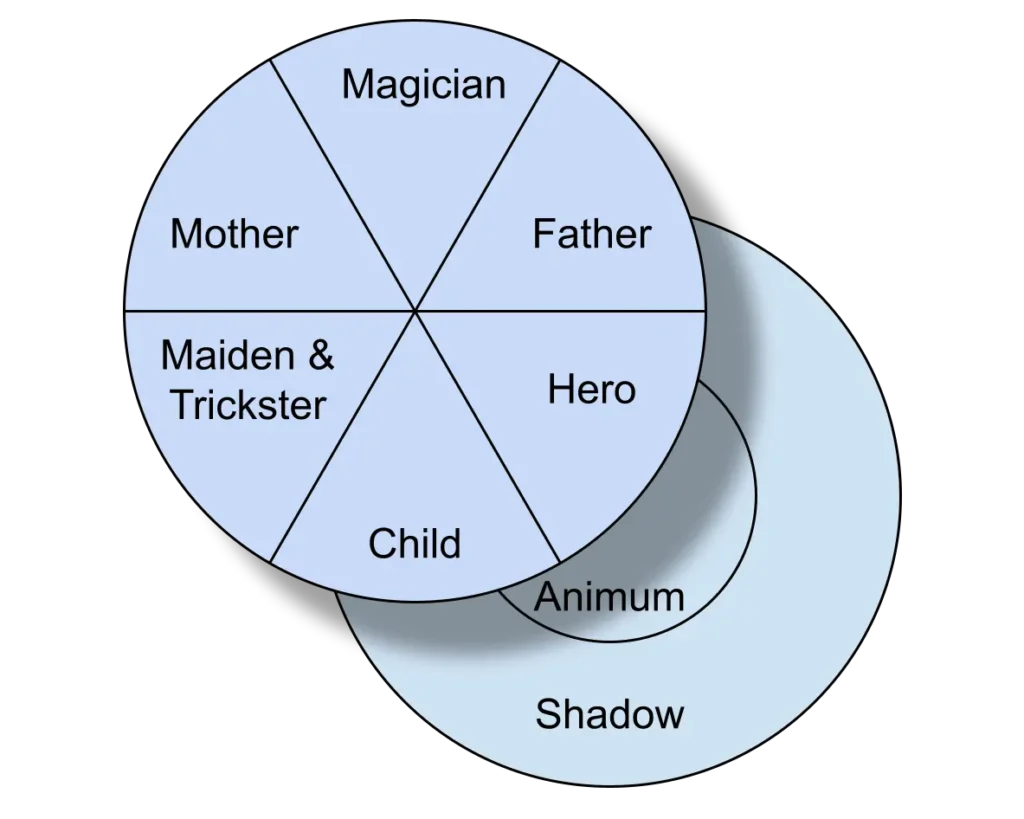
This diagram shows the relationships between the nine primary character archetypes.
Archetypes situated next to each other share certain commonalities. Those across from each other are opposites in some way.
The child, trickster, and maiden all share a tendency to focus on the immediate or near term. The maiden, trickster, and mother share a perspective grounded in feeling and relationships. The child and hero share a tendency toward self-interest and aspiration. The hero and father share a tendency toward idealism and essentialism. The magician archetype reflects a balance between (or transcendence of) the mother, maiden, and trickster on one side and the father and hero on the other.
Archetypes that appear opposite each other in the diagram present opposed perspectives. The father thinks in terms of rules and principles, while the trickster and maiden find little use for such abstractions. The hero sees people as individuals, while the mother sees people primarily as members of families, communities, and other groups. The child and magician are not adversarial, but rather the child reflects a potential, and the magician, a realization of potential.
The shadow and animum (i.e. animus and anima) are more idiosyncratic archetypes. They don’t manifest in stories by themselves, but only in relation to a counterpart. The shadow represents an aspect of the counterpart’s personality, while the animum reflects a unrecognized capacity.
Event Archetypes
Event archetypes (or archetypes of transformation) are grounded in orientations toward certain situations that all or most people will encounter in their lives but are not persistent factors. They serve to reorient us according to changes in our lives or our environment.
Event archetypes typically correspond to significant challenges and opportunities (e.g., disasters and epiphanies), to important moments in life (e.g., births and marriages), and to holidays (e.g., New Year’s Day, Easter, and the solstices). In narrative terms, event archetypes are frequently associated with the Hero’s Journey as popularized by Joseph Campbell.